
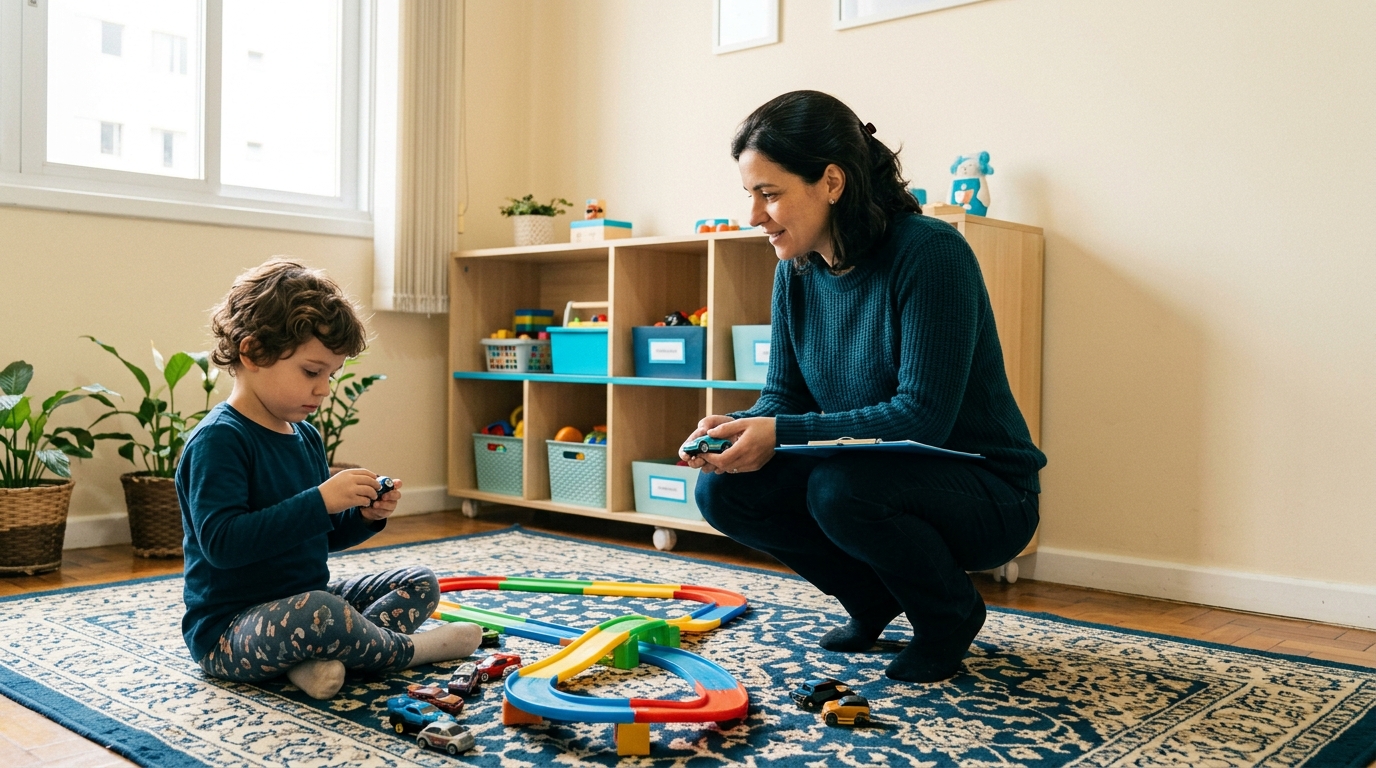
In Applied Behavior Analysis, play is a planned teaching context. Play builds motivation, creates opportunities for verbal and social behavior, and helps the child use what they learn outside the session.
Anyone who works with autistic children in ABA has heard a family member ask, “So you just played today?” It’s a fair question, and it deserves a technical answer. What sets a professional apart in that moment is being able to explain which goal was targeted during that play, how progress was measured, and why that format was chosen.
To an outside observer, play can look like a break between the “real” activities. In ABA, it is intervention because it serves functions that tabletop teaching alone does not: it increases the child’s motivation to respond, creates natural opportunities for communication and interaction, and brings teaching closer to the situations where the skill will be used in everyday life. But this only happens when play has defined targets, planned contingencies, and data collection. Without that planning, it really does become a break. This article shows how to turn play into teaching.
What play means in ABA
Play in ABA means using playful activities as a context for teaching socially significant behaviors. Play serves as both a source of motivation and a teaching environment, and every interaction can be a learning opportunity with an antecedent, a response, and a consequence.
This use of play appears in the literature under names such as Natural Environment Teaching (NET) and, more broadly, Naturalistic Developmental Behavioral Interventions (NDBI). Models such as Pivotal Response Treatment (PRT), the Early Start Denver Model (ESDM), and JASPER belong to this group and place play at the center of the session.
There is also a second, equally important meaning. Play itself can be an intervention target. Restricted, repetitive patterns of behavior and interests are part of the diagnostic criteria for Autism Spectrum Disorder (ASD), and they often show up in play: many children with ASD start services playing the same way every time, with few objects, or without using toys functionally. Expanding that repertoire is already a clinical gain, because play is the main way children interact with one another.
Why play supports motivation and generalization
The case for play in ABA rests on two core concepts in behavior analysis. The first is the motivating operation: when the child wants something within the play, the value of that item as a reinforcer increases, and so does the likelihood that they will emit the response you are teaching.
The second is generalization. Skills taught only at the table, with a single material and a single person, tend to stay tied to that context. When teaching happens in varied situations that resemble the child’s routine, with different toys, different people, and natural reinforcers, the child is more likely to use the skill at home, at school, and with other children.
In practice, this means that a request like “I want the car,” made during play and reinforced with access to the car, is closer to real life than the same request trained with flashcards. Both teaching approaches have their place, and the choice depends on the goal and on where the child is right now.
How to use play in ABA intervention in 5 steps
Turning play into intervention takes the same rigor as any other procedure. The steps below organize planning from first contact through data collection. They are not always linear: preference assessment, for example, is repeated throughout services.
1. Assess the child’s play repertoire and preferences
Before planning, observe how the child plays today. Do they explore objects, use toys functionally, engage in pretend play? Do they play alone, alongside other children, or with them? Alongside this, conduct preference assessments to identify which items and activities have the highest reinforcing value. Preferences change, so this check needs to happen often.
2. Pair yourself with reinforcers
Pairing is the process of associating your presence with access to good things, with no demands at first. The goal is for the professional to take on reinforcing value for the child. Without this step, the child tends to avoid interaction, and play loses its function as a teaching context.
3. Define operational targets within play
Decide in advance what you will teach and write the target in observable terms. “Interact better” is not a measurable target. “Make a vocal request for an item during play, without a prompt, in 4 out of 5 opportunities” is. Targets can involve verbal behavior (mands, tacts, intraverbals), imitation, joint attention, turn-taking, or play itself.
4. Arrange the environment to create opportunities
This is where controlling access comes in. Keep preferred items in sight but out of reach, hand out pieces a few at a time, start an activity and pause halfway through, offer a closed container. Each arrangement creates a situation in which the child has a reason to communicate or interact. Whenever possible, the reinforcer should be the natural consequence of the response: they ask for the ball, they get the ball.
5. Collect data and plan for generalization
Play with a clinical purpose is documented, like any other procedure. Record opportunities, responses, prompt level, and mastery criteria. With the data in hand, plan variation in materials, people, and settings, and involve family members and school when it makes sense. This record is what lets you answer the question “What did you do today?” with confidence.
Examples of play activities in ABA therapy for autistic children
The examples below show how everyday activities can support different targets when working with children with ASD. The toy is the same one the child would find at home or at school. What changes is the planning behind each interaction.
Bubbles
You blow a few bubbles and stop, holding the bottle closed. The pause creates an opportunity for a mand (“bubble,” “more,” “blow”). Depending on the child’s repertoire, the target can be vocal, signed, or a picture exchange. The consequence is immediate and natural: more bubbles.
Car track
Autistic children often show interest in lining up cars or watching the wheels spin. That interest can be the starting point: you join the play, use the preferred cars as reinforcers, and gradually expand what the child does with them. A track lets you work on tacts (“red,” “fast”), imitation of actions with objects (“do this”), and turn-taking (“my turn, your turn”). If the target is play itself, you can model functional sequences, such as loading the truck and driving it to the garage.
Playhouse and pretend play
Feeding the doll, putting it to bed, pretending a block is a phone. These activities teach symbolic play and make room for simple intraverbals, such as answering “What is the doll going to eat?” They also serve as a bridge to peer play, since pretend play is very common among young children.
Rule-based games with peers
For children with a broader repertoire, simple board games or hide-and-seek let you teach waiting, following rules, coping with losing, and initiating interaction with another child. This kind of target becomes especially important when the autistic child attends a general education classroom, where recess and group play make up much of social life. The professional gradually fades out so that peer interaction can be sustained without mediation.
Structured vs. Naturalistic teaching: what’s the difference in ABA
A common question is whether play replaces discrete trial training (DTT). It does not. The two formats have different strengths and, in many intervention plans, coexist in the same week or even the same session. The comparison below helps you decide when to use each.
In discrete trial training (DTT), the work usually takes place at a table or in a structured setting. The professional typically initiates each trial and also selects the materials. The reinforcer may be arbitrary, such as a token or a preferred item with no direct relation to the response. The number of trials is high, with massed repetition, which is why this format supports rapid acquisition of new skills.
In Natural Environment Teaching (NET), the context is the child’s play and routines. The child usually initiates, based on their own interests, and materials are chosen according to their preferences. The reinforcer is ideally natural and tied to the response: if the child asks for the ball, they get the ball. Trials are fewer and spread throughout the activity. This format’s strength lies in motivation and in the generalization of what was learned.
The choice is not ideological. A skill can be acquired in a structured format and then carried into play, or the other way around. What guides the decision is the child’s data.
Play in ABA and collaboration with other disciplines
The use of play is not exclusive to ABA. Occupational therapy, speech-language pathology, educational psychology, and developmental psychology have long used play, each with its own frameworks. ABA’s contribution is to add tools for functional analysis, operational definition of targets, and continuous measurement.
In practice, this supports teamwork. When the behavior analyst records that the child makes vocal mands while playing with bubbles, the speech-language pathologist gains useful data for their own planning, and the occupational therapist can use the same context to work on other skills. Shared goals and a common language across disciplines tend to benefit the child.
What the research says about Naturalistic Teaching
In 2015, a group of researchers from the behavioral and developmental fields published an article in the Journal of Autism and Developmental Disorders that brought together, under the name: NDBI, interventions for autistic children that combine principles of behavior analysis with natural contexts and play. The article describes the common components of these models, such as following the child’s lead, using natural reinforcers, and arranging the environment to create learning opportunities.
For professionals, the message is clear. Play with a clinical purpose is grounded in the literature and aligned with the principles that have supported ABA from the start.
Take your ABA practice further
Planning play-based sessions with clear targets, choosing between structured and naturalistic teaching, and analyzing data to adjust intervention are skills developed through solid training and supervision. If you want to expand that repertoire, explore ABAEDU’s U.S. Master’s in ABA!